
 Contact us here to plan your future trip to French Polynesia

Bora Bora Whale Season —
Whale Watching Tours,
Best Time & Tips 2026
Every year from July to November, humpback whales migrate to the warm waters of French Polynesia to breed and give birth. Watching a 40-tonne humpback breach within sight of Mont Otemanu is a moment that stays with you for life. But whale watching in Bora Bora requires honest planning — the season has a clear start and a legal end date, July sightings are not reliable, and the experience itself is demanding enough that you should never combine it with a lagoon tour on the same day. This guide tells you everything about whale watching in Bora Bora: when to go, when not to go, which tours to book, and what to realistically expect.
Everything you need to know about whales in Moorea and Tahiti
| Operator | Format | Price | Why we recommend it |
|---|---|---|---|
| Tohora Bora Bora ★ | Half day · Shared | $300/pp | 15+ years of experience, Simon is the pioneer of whale watching in Bora Bora. Hydrophone on board. Our #1. |
| Bora Ocean Adventures | Half day · Private boat | $1,500 | In-water encounters with humpbacks, professional team, 100% focused on whale well-being. |
| Private Whale Watching Cruise | Half day · Private cruise | $300/pp | Intimate sailing format, itinerary adapted daily to whale sightings. Ideal for couples. |
Bora Bora whale season — month by month
The whale season in Bora Bora runs from July to November — a five-month window that sees thousands of humpback whales transit through French Polynesia on their annual migration from Antarctic feeding grounds. Understanding the whale season Bora Bora visitors experience month by month is the key to planning a successful trip.
Humpback whales (Megaptera novaeangliae) arrive in French Polynesia from July and depart by November, completing one of the longest migrations on earth — up to 10,000km from Antarctic feeding grounds. The dates are formal and regulated by French Polynesian law — whale watching tours are not permitted outside the official season.
| Month | Status | What to expect |
|---|---|---|
| Jan–Jun | No whales | Whales are in Antarctic feeding grounds |
| July | Early season ↑ | First arrivals, still spread out. Sightings possible but unreliable. Our honest advice: don't book in advance — see below. |
| August | ★ Peak season | Population builds rapidly. Mothers with calves. High sighting probability. |
| September | ★★ Best month | Maximum population. Most reliable sightings. Most surface behaviour visible. |
| October | ★ Excellent | Still abundant. Calves growing. Active surface behaviour continues. |
| November | Departing ↓ | Good sightings early November. Season ends mid-November by law. Do not book late November. |
| December | No whales | Migration back to Antarctic feeding grounds |
Best time for whale watching in Bora Bora
The best time for whale watching in Bora Bora is September — the population is at its peak, surface behaviour is most active, and conditions are most reliable. August and October are excellent alternatives. July is early season with unreliable sightings. After mid-November, the season is legally closed.

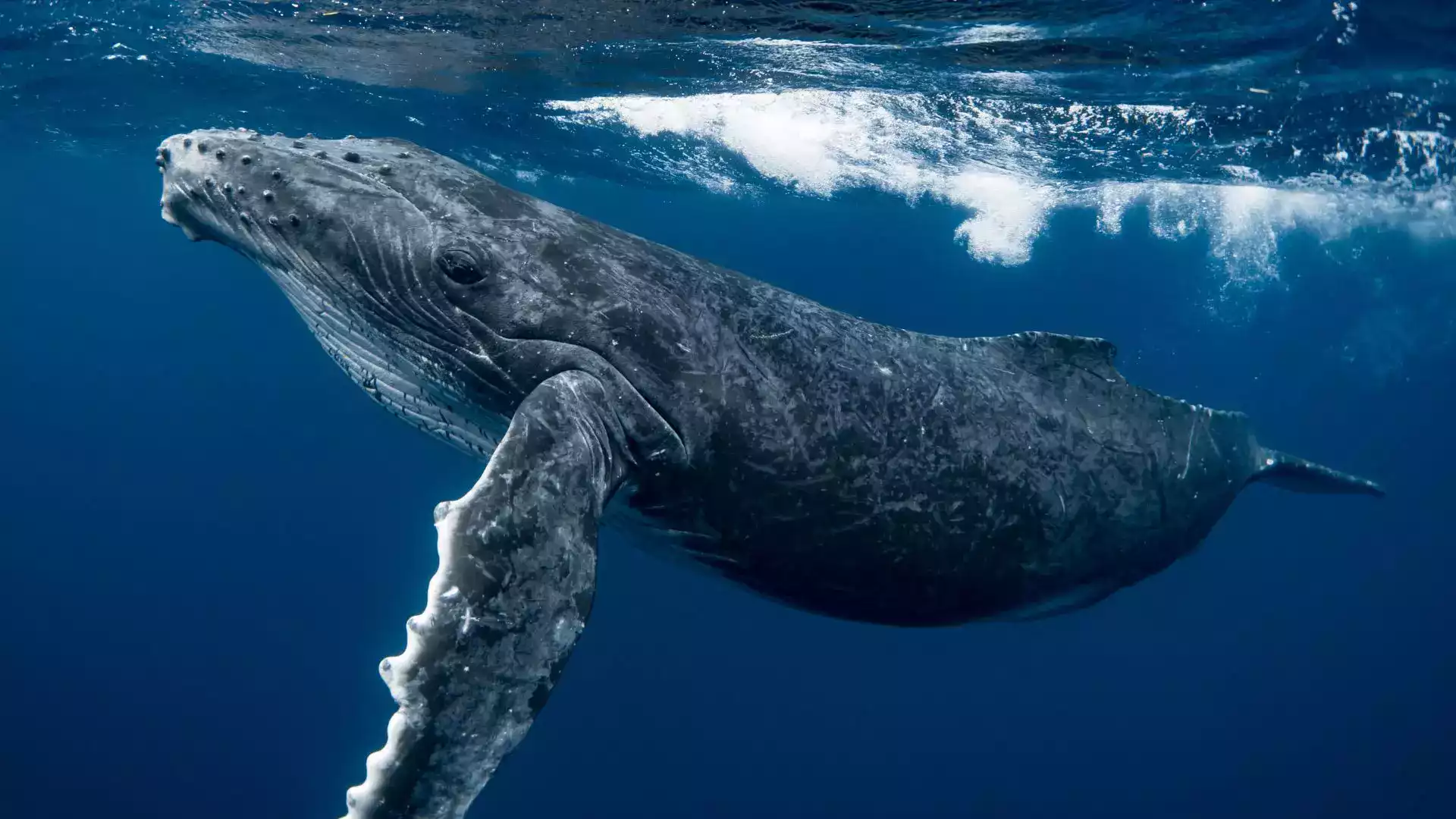
Humpback whale breaching in French Polynesia — the extraordinary encounter that draws thousands of visitors to Bora Bora every year between August and October
July — why we don't recommend booking in advance
July is the start of the season, but the whales are still arriving and spread across a wide area. Sightings are possible — but they are far from reliable. Our honest advice: don't book a whale watching tour in advance if July is your only window. Instead, ask at your hotel when you arrive. The front desk staff and concierge are in daily contact with local operators and will know whether whales have been spotted in the last 24–48 hours. If conditions are favourable, book last-minute. If they haven't been seen for days, save the half-day for another activity.
Book a whale watching tour in July only if you are staying 5+ days and have the flexibility to go on short notice. Ask your hotel each morning — local knowledge is worth more than any advance booking in the early season.
November — the season has a legal end date
Whale watching in Bora Bora is regulated by French Polynesian law, which sets a strict end to the season. Operators are not permitted to run whale watching tours after mid-November. This is not a suggestion — it is a legal framework that all licensed operators must follow. The dates are enforced.
Early November can still offer excellent sightings — whale numbers are declining but encounters remain frequent. If you're visiting in the first two weeks of November, a whale watching tour is absolutely worthwhile. From mid-November onwards: don't book one. The season is over, the whales are leaving, and no licensed operator will take you out.
Book confidently for early November (1st–10th). After the 10th, check with your hotel on current conditions. After mid-November: skip the whale watching tour and add a lagoon tour instead.

Humpback whale surface behaviour in French Polynesia — breaching, tail slapping and spy hopping are most frequently observed during August–October
The whale watching experience in Bora Bora
A half day whale watching Bora Bora experience typically departs in the early morning (6:30–7:00am) for a 3–4 hour excursion by boat — in open ocean, outside the lagoon. This is important to understand: whale watching is not the same as a lagoon tour. The open ocean can be rough, the boat is smaller, and you will be swimming in deep water if an in-water encounter is offered. It is physically demanding. Most people find it deeply rewarding — but it is not a relaxed catamaran experience.
What you might see
Breaching — a full humpback launching itself out of the water. One of the most spectacular wildlife displays on earth. Most common August–October.
Tail slapping (lobtailing) — the whale raises its tail fluke and slaps the water repeatedly. Very audible and visible from a distance.
Spy hopping — the whale rises vertically to observe its surroundings. An intimate moment — the whale is essentially looking at you.
Mother and calf — the most moving encounter. Calves stay close to their mothers, learning and playing at the surface.
Singing — detected via hydrophone. Male humpbacks produce complex, evolving songs. Hearing a whale sing while floating on the surface of the ocean near Bora Bora is an experience with no parallel.
Ethical whale watching Bora Bora — regulations & what to look for
French Polynesia has some of the strictest cetacean protection regulations in the Pacific. All operators must hold a specific licence from the Direction des Ressources Marines (DRM). Ethical whale watching in Bora Bora means: approaching whales slowly and obliquely, cutting the engine within 100 metres, never blocking a whale's path, and limiting in-water time. Ask your operator about their approach protocol before booking — a responsible guide will have clear answers.
No whale watching tour can guarantee a sighting — whales are wild animals. During August–October, the probability of encountering humpbacks in Bora Bora is very high. Most reputable operators offer a free rebooking if no whales are spotted.
Best whale watching tours in Bora Bora
Whale watching is a minority activity in Bora Bora compared to Moorea — there are fewer dedicated operators, but the ones that exist are excellent. Three tours stand out on Viator. Book 6 months in advance for August and September — availability is extremely tight at peak season.
Tohora Bora Bora ★ — our #1 recommendation
Tohora Bora Bora was the first company in Bora Bora to introduce whale watching to a wide public — with over 15 years of experience observing and approaching humpback whales. Simon, the guide and founder, is a passionate expert who shares his knowledge with deep respect for the animals. The boat is equipped with a directional hydrophone offering exceptional sound quality for listening to the whales' majestic songs. Tohora is the pioneer of ethical whale watching in Bora Bora — and our #1 recommendation.
Book Tohora Bora Bora · $300/pp Tohora Bora Bora — Whale Watching Bora Bora · Pioneer Since 15+ Years Shared whale watching tour — experienced guide, small group, best value in Bora Bora for cetacean encounters.Whale watching and lagoon tour — do them on separate days
This is advice we give to every visitor who asks: do not combine your whale watching tour and your lagoon tour on the same day. They are two completely different experiences, and doing both in one day means doing neither properly.
The whale watching tour is a half-day in open ocean — early morning departure, potentially rough seas, active swimming if an in-water encounter is offered. It is physically demanding and emotionally intense. You will come back tired, exhilarated and full of adrenaline. That is not the state in which you want to jump back on a boat for a lagoon snorkeling tour.
The lagoon tour, on the other hand, is a day of calm water, stingrays, sharks, coral and motu lunch. It deserves its own full day of energy and attention.
Day 1 (or early in your stay): whale watching tour — half day, early morning. Rest in the afternoon. Day 2 (separate day): lagoon tour — full day snorkeling with rays, sharks and motu lunch. You'll get the most out of both experiences.
Whale watching: Bora Bora vs Moorea
Moorea is the most reputed island in French Polynesia for whale watching. It has the highest concentration of dedicated operators, the most established infrastructure for ethical in-water encounters, and a whale population that has been consistently present in its two bays for decades. If whale watching is the primary reason for your trip to French Polynesia, Moorea should be your base.
Bora Bora's whale watching is different — more discreet, with fewer operators, but every bit as extraordinary when it happens. The dramatic setting (open ocean with Mont Otemanu visible in the distance) gives Bora Bora encounters a visual dimension that Moorea cannot match. And because fewer tourists are doing it, the experience feels more exclusive.
Moorea is also significantly cheaper. With more operators competing for the same market, prices are lower — around $200 per person for a shared tour in Moorea, compared to $300+ in Bora Bora. The experience itself is very similar: the same humpback species, the same behaviours, the same ethical regulations. The main difference is the setting and the number of operators.
One important note: there is no point doing a whale watching tour twice on the same trip. Once you've had the encounter — whether in Moorea or in Bora Bora — you've had it. The experience doesn't compound with repetition. Choose one island for whale watching and dedicate your other island's time to different activities.
Our recommendation: if your itinerary includes both islands, do your whale watching in Moorea (more operators, lower price, more reliable) and focus your Bora Bora days on the lagoon tour, helicopter or 4x4. If you only visit Bora Bora, the local tours are excellent — just book early.
The reference destination Swim with Humpback Whales in Moorea — Season, Price & Best Tours Moorea is the most reputed island in French Polynesia for whale watching — more operators, more reliable encounters, more established in-water infrastructure.
Whale watching in French Polynesia — Moorea leads for dedicated operators, Bora Bora offers an unmatched dramatic setting
The top whale watching operators in Moorea — more operators and lower prices (~$200/pp) than Bora Bora, with a similarly exceptional experience
Practical tips for whale watching in Bora Bora
| Tip | Why it matters |
|---|---|
| Book 6 months ahead for Aug–Sept | Peak season availability is extremely tight. These are the most sought-after months — don't leave it to the last minute. |
| In July: ask your hotel, book last-minute | Sightings in July are unreliable. Your hotel concierge has real-time information from operators — use it. |
| Don't book after mid-November | The season ends by law at mid-November. No licensed operator will take you out after this date. |
| Do it on its own day | Whale watching is physically demanding — open ocean, early morning, active swimming. Don't combine it with a lagoon tour on the same day. |
| Book the morning tour | Whales are most active at the surface in the early morning. The ocean is also generally calmer before midday. |
| Bring a warm layer | Early morning open-ocean departures can be cool. A light windbreaker is essential. |
| Use polarised sunglasses | They cut glare dramatically, making it much easier to spot blows (the water spout from a surfacing whale) at distance. |
| Camera ready, burst mode on | Breaching is sudden and brief. Be ready. Phones work well — don't underestimate them. |
FAQ — Whale Watching in Bora Bora
Plan your Bora Bora & French Polynesia trip
Moorea guide Best Things to Do in Moorea — Complete Guide 2026 We live here — the insider guide to Moorea's beaches, snorkeling and whale season. Plan your trip Tahiti Itinerary 10 Days — Bora Bora, Moorea & French Polynesia How to time your visits to Bora Bora and Moorea for whale season. Where to stay Best Overwater Bungalows in Bora Bora — Resort Comparison Where to stay in Bora Bora during whale season — resorts with the best views and pontoon access.

